
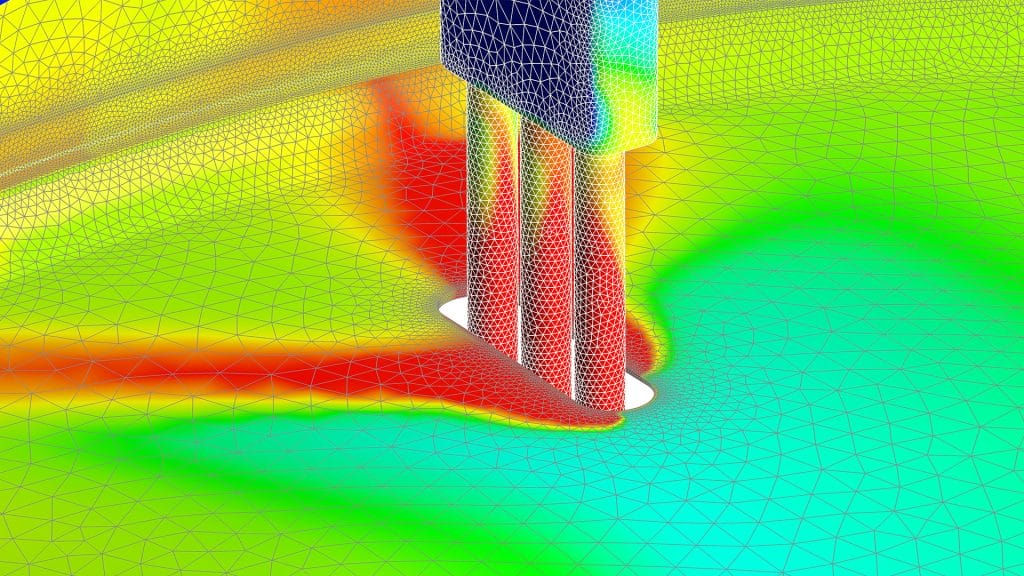
 Every new design project comes with its own unique functional and performance requirements. If there wasn’t some aspect of the product that needed improving, you wouldn’t have to design anything.
Whatever the ultimate goals of the design — weight reduction, aerodynamics, power efficiency, strength, etc. — simulation can help you get it right. Strategically incorporating simulation cycles early in the design lifecycle (what’s known as “shifting analysis left”) can guide the entire process so you more efficiently achieve a more effective design.
What Simulation to Use
Simulation and analysis comes in many forms and depending on the project, only certain types will be a good use of time and resources. Finite Element Analysis (FEA) is key for some scenarios, Computational Fluid Dynamics (CFD) or electromagnetics in others, and so on.
As you plan the design process, there are four primary facets to consider for any given project:
- What physics enable the product’s primary function?
- What physics could cause performance failure?
- What are the operating environment’s dominant loads?
- What elements or materials significantly interact with the design?
For each, you also need to factor in two variables:
- How your design would benefit from simulation in 1D, 2D or 3D.
- The level of detail your analysis requires.
Taken together, this information will ensure that you’ve planned the right amount of simulation and analysis at the right stages to not only get the design right, but optimize your process.
To get a detailed breakdown of the broad categories of simulation and what questions will guide your use of specific functions, including examples of how they apply to designs of certain products, read the the eBook, “How engineering simulation can improve your product development process: A decision framework for more successful projects.”