 Engineers may see the appeal of an embedded thermal solver and still wonder, “How would we use it in our software?”
It’s likely the design and development teams at your organization already have specialized applications for designing a product or predicting how it will perform. There might even be internally developed, proprietary analysis codes to support R&D.
A software development kit allows a new analysis function to live inside the engineering software where the rest of the work already happens. Your preferred application calls the dedicated thermal solver and passes the results back into its own workflow. Sound intriguing?
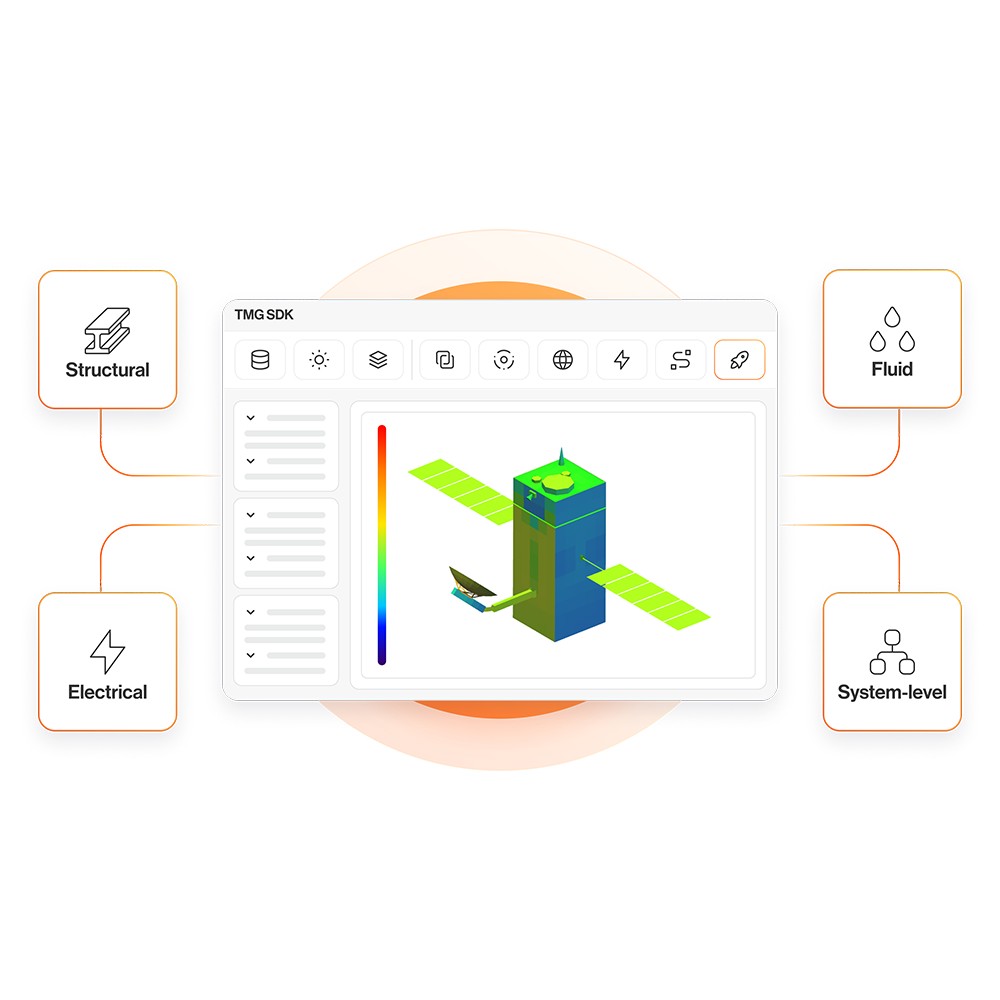
Explore the TMG-SDK from Maya HTT. This new software devkit exposes the powerful and proven TMG thermal solver through a pure C API that’s already been embedded in Python and JavaScript. The solver supports finite volume and finite element formulations for conduction, convection, and radiation thermal analysis.
Here are five examples of how that could work.
1. Add Thermal Analysis to PCB and Semiconductor Software
The electronics design software used by the engineers may already model board layouts or semiconductor performance. TMG-SDK would add temperature prediction to that existing workflow.
Consider a CPU or graphics processor. These devices generate concentrated heat during operation. Inadequate cooling can force the processor to throttle its performance and run much slower. Excessive temperature can also damage components.
An electronics engineer could use TMG-SDK to calculate chip or board temperatures based on the design being analyzed. Engineers would then be able to examine component temperatures and heat-transfer paths alongside the other results their software already produces.
It would be easy for the development team to call the thermal solver from a Python-based workflow to further automate studies as power levels or cooling configurations change.
2. Evaluate LED Heating in Headlamp Design Software
Consider a high-powered lighting application like a headlight for a car or truck. Headlamp design mainly focuses on optical calculations as engineers develop the reflector geometry and determine the resulting light pattern.
However, the LED lights emit a huge amount of heat that can damage the surrounding plastic reflectors and lenses. So, although the focus is to design a light that produces the required brightness and focus pattern, engineers must also manage heat to guarantee lifespan and durability.
A developer can embed TMG-SDK behind the existing interface. The main application sends geometry along with material data and boundary conditions to TMG, and the resulting temperature field is an additional input for the headlamp design process. Once the optical geometry is defined, the same design information helps calculate temperatures in the LED assembly and surrounding components.
You can add thermal performance as another design criterion available inside a tool already centered on lighting performance.
3. Account for Thermal Expansion in Antenna Design
Wi-Fi and cellular antennas are tuned to operate at specific frequencies (like a radio station). Physical dimensions are a big part of how they’re tuned.
High-powered antennas also generate heat during operation — and perhaps not in a uniform pattern, which can throw off the frequency calibration (due to the way that materials expand when heated). Temperature distribution may vary through the structure, too. As materials heat up, thermal expansion alters the antenna geometry ever so slightly, but definitely enough to influence its frequency response.
TMG-SDK can supply the thermal portion of a coupled antenna analysis. The application could calculate the temperature field and use those temperatures in a structural calculation of thermal expansion. The updated geometry could then feed the electromagnetic analysis.
This type of co-simulation is a great solution for specialized antenna applications, as they can now account for a physical effect outside of their primary analysis domain.
4. Automate Battery Pack Cooling Studies
Temperature affects the performance and durability of battery packs, including the large ones in electric vehicles as well as the tiny ones in cell phones. Excessive temperatures accelerate the degradation of the battery’s life and, in the event a battery overheats, can risk starting a fire. Even temperature differences among the individual cells will impact pack performance.
Battery-system software could use TMG-SDK to analyze cooling concepts inside its established design workflow. Engineers may, for instance, compare two cold-plate designs or evaluate coolant flow rate. The thermal solver in TMG is capable of calculating peak cell temperature and helping designers achieve temperature uniformity (across cells) for each configuration.
The SDK also supports automation. A proprietary optimization program could launch a series of thermal simulations under different operating conditions. It could retrieve each result and compare candidate designs according to the manufacturer’s existing engineering criteria.
TMG-SDK gives the R&D team a high-fidelity thermal simulation solution for internal tools, developed around their own battery technology.
5. Model Temperature Effects in Solar Panel Software
Solar panels are obviously exposed to direct sunlight, but in various intensities throughout the day as the sun moves across the sky. The gradual temperature changes affect the solar panels ability to generate electricity. A design tool focused on power generation can benefit from analysis and data on the corresponding thermal state.
A solar-panel application could call TMG-SDK to calculate operating temperatures for a particular design under defined environmental conditions, then feed those temperatures to the software’s electrical-performance calculations.
With the combined workflow in hand, it’s easier for engineers to evaluate design changes that will control temperature and preserve electrical output. A manufacturer could apply the same approach inside proprietary R&D software and retain its existing methods for evaluating panel performance.
Add TMG-SDK to an Existing Engineering Application
Each example above follows the same essential integration concept. The existing software continues to handle the same specialized engineering problem it was developed to solve. TMG-SDK — as an extra layer integrated into that software — supplies thermal physics when and where temperatures will influence the calculation. It sits right inside your team’s preferred commercial software or a proprietary R&D tool and supports Python automation or coupled simulation.
If your engineering application already predicts the behavior of a physical device or system, map the inputs required by the thermal solve and the results that must return to the host application. Maya HTT is ready to help you determine how TMG-SDK will connect to that architecture and contribute thermal capabilities to your analysis.